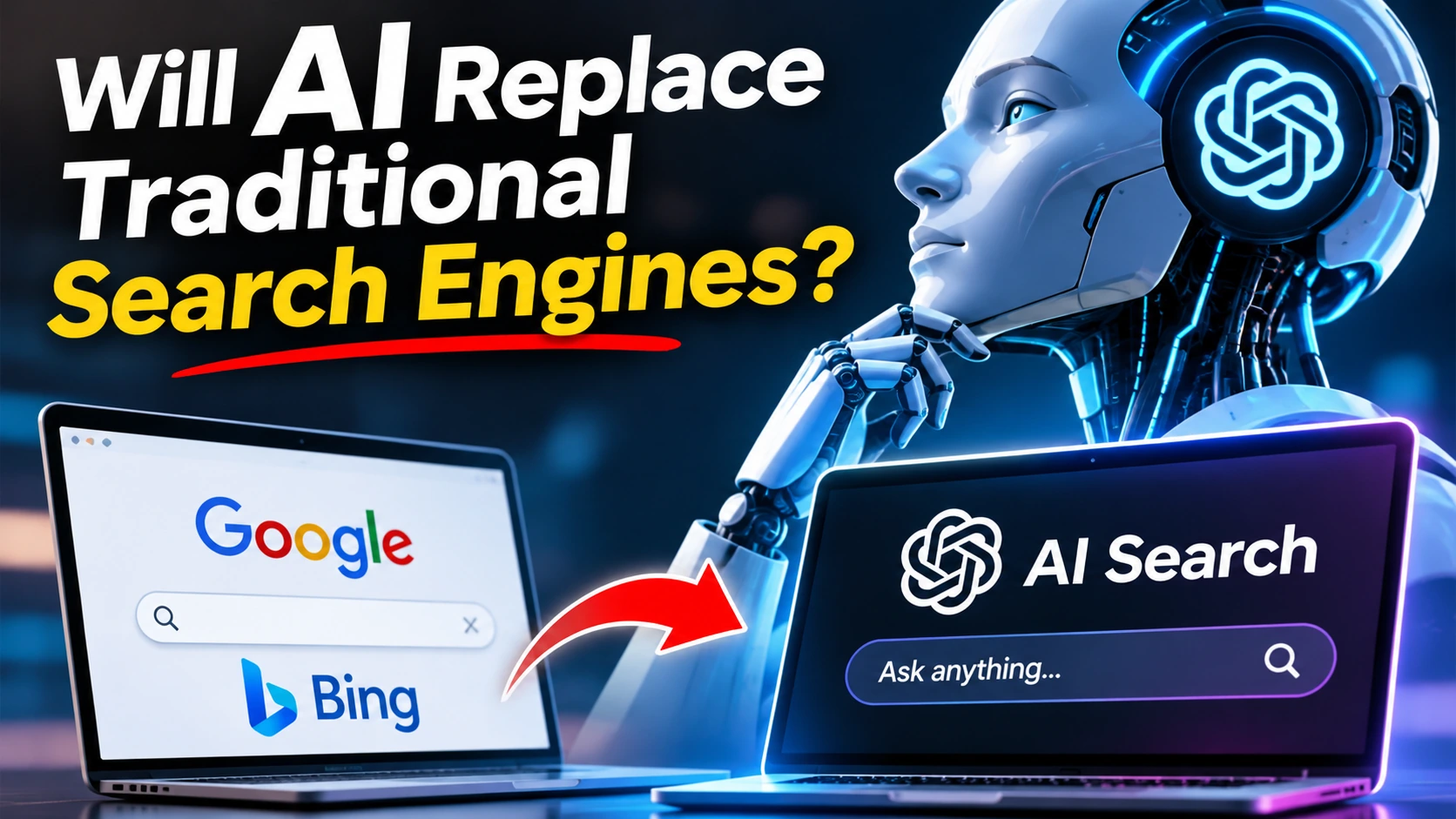
For many years, traditional search engines have been the primary way people find information online. Whether someone wants to research a topic, compare products, discover a destination, or find an answer to a question, search engines provide access to millions of websites.
However, the growth of Artificial Intelligence is changing how people discover and consume information. Instead of entering keywords and browsing multiple links, users can now ask AI tools direct questions and receive conversational answers.
This development has created an important question: Will AI eventually replace traditional search engines, or will both technologies continue to work together?
1. How Traditional Search Engines Work
Traditional search engines help users find relevant information by organising and indexing webpages across the internet.
When someone enters a search query, the search engine analyses the words and identifies webpages that may provide useful information.
Its ranking systems consider several factors, including relevance, content quality, website structure, freshness, and other signals.
The results are generally displayed as a list of links, allowing users to visit different websites and explore information directly.
This approach gives people access to multiple perspectives and original sources.
However, users may need to open several pages, compare information, and spend time identifying the most reliable answer.
2. How AI Search Tools Are Changing Information Discovery
AI-powered search tools offer a different way to discover information.
Instead of simply displaying a list of webpages, these systems can interpret natural language questions and generate conversational responses.
For example, someone researching international travel may ask an AI assistant to compare destinations based on weather, budget, and sightseeing opportunities.
The system can organise relevant information into a structured explanation rather than requiring the user to search for each detail separately.
Some AI search platforms also provide links to supporting webpages, allowing users to verify information and explore original sources.
This makes online research more conversational and accessible.
3. Why People Are Becoming Interested in AI Search
One major reason for the growing interest in AI search is convenience.
Traditional searches often require users to create several queries to find different parts of an answer.
AI tools can sometimes address multiple related questions within a single conversation.
For example, someone planning to purchase a laptop may ask about specifications, battery life, suitable uses, and important buying considerations together.
AI can organise these requirements into a single response.
Another advantage is that users can ask follow-up questions without starting their research from the beginning.
This conversational experience makes information discovery easier for people who are unfamiliar with technical search terms.
4. Can AI Provide More Personalised Search Results?
AI systems can use conversational context to provide answers that are more relevant to a user’s stated requirements.
For example, if someone asks for holiday destinations within a particular budget, an AI assistant can focus its suggestions on that financial limit.
Traditional search engines also personalise some results using factors such as location, language, and search settings.
However, AI assistants can make personalisation feel more interactive because users can explain their preferences through natural conversations.
The challenge is ensuring that personalisation does not reduce exposure to different viewpoints or introduce unnecessary assumptions.
5. The Accuracy Problem: Can AI Always Be Trusted?
One of the biggest challenges associated with AI-generated search answers is accuracy.
AI systems may sometimes generate incorrect information, misunderstand questions, or present outdated details confidently.
This can happen because generative AI produces responses based on learned patterns and available information rather than independently guaranteeing that every statement is true.
Traditional search engines also display inaccurate information because not every indexed webpage is trustworthy.
However, they allow users to compare multiple sources directly.
For important topics involving health, law, finance, or public safety, users should verify information through authoritative sources and qualified professionals.
6. Why Traditional Search Engines Are Still Important
Despite the growth of AI, traditional search engines continue to offer several valuable features.
Direct website access: Users can visit original websites instead of relying only on generated summaries.
Multiple perspectives: Search results allow people to compare information from different publishers and organisations.
Local discovery: Traditional search remains useful for finding nearby businesses, services, restaurants, and physical locations.
Shopping research: Users can explore product listings, specifications, reviews, and retailer websites.
Fresh information: Search engines help people discover recent news, announcements, and updates from original publishers.
For these reasons, traditional search is unlikely to become irrelevant in the immediate future.
7. How AI Search Is Changing Digital Marketing and SEO
The growth of AI search is also influencing how businesses create and optimise online content.
Traditional SEO focused heavily on improving webpage visibility for relevant search terms.
While keywords and technical optimisation remain important, businesses increasingly need to create content that directly answers user questions.
Clear explanations, accurate information, useful examples, and well-organised headings can improve the usefulness of online content.
Businesses should also maintain reliable author information, update outdated articles, and provide supporting evidence where appropriate.
AI search may change how users discover websites, but high-quality content remains valuable.
8. Will AI Replace Search Engines Completely?
A complete replacement is not guaranteed.
AI assistants and traditional search engines serve overlapping but different purposes.
AI is particularly useful for explaining concepts, summarising information, organising research, and answering conversational questions.
Traditional search engines remain valuable when users want to visit specific websites, compare original sources, find local businesses, or access particular webpages.
The future may involve closer integration between these technologies.
Search platforms are already experimenting with AI-generated summaries and conversational search features, while AI assistants increasingly use web search to provide current information.
This suggests that both technologies may become parts of a connected information ecosystem.
9. What Will the Future of Online Information Look Like?
Future search experiences may combine conversational AI, traditional webpage results, voice-based interactions, and personalised recommendations.
Users may be able to ask complex questions, receive organised answers, and immediately access relevant original sources.
AI could also make information more accessible through multilingual explanations and simpler summaries.
However, digital literacy will become increasingly important.
People will need to understand how to verify information, recognise misleading content, and distinguish between AI-generated responses and original reporting.
The ability to evaluate sources will remain an essential skill even as technology becomes more advanced.